Table Of Content

Third, in this article we assumed a research situation in which a researcher is interested in analyzing immediate treatment effects and differences in mean level, but in which unexpected linear trends in the data hamper such analyses. In this context it is important to mention that over the years multiple proposals have been made concerning how to deal with the presence of trends in the statistical analysis of single-case data. The possibilities to deal with trends in single-case data are numerous and beyond of the scope of the present article. In conclusion, both the ABA and ABAB designs offer valuable insights into the effectiveness of interventions in applied behavior analysis.
Breaking the Silence: The Impact of Emotional Exhaustion on Autism
Overall, our findings suggest that practitioners may not always need to conduct a replication in practical settings and that measures of effect size may provide a convenient aid to decisions about when to conduct a return to baseline and replication of intervention. We emphasize, however, that at present, there exists limited empirical guidance for such decisions. There is no reason to expect that a single relationship between effect size and replicability holds for all circumstances. In the present analyses, we pooled data from, and treated as interchangeable, a wide variety of investigations that subsumed many different target behaviors, types of disorder, and settings. Such factors may well influence the probability of replication, and so additional research is needed in which these factors are treated as covariates.
B phase trend (β
After the intervention phase is complete, the researcher returns to the baseline phase to observe the behavior without the intervention again. This allows for a comparison of the behavior with and without the intervention, providing valuable insights into the effectiveness of the treatment. The independent variable (in this case, the token reinforcement system with the increasing dB criterion) was actively manipulated by the researchers, and the dependent variable was measured systematically over time. Each phase included a minimum of three data points (but not the five points required to meet the standards fully), and the number of phases with different criteria far exceeded the minimum three required.
What is ABA Therapy?
ABA programs are highly individualized and tailored to meet the unique needs of each individual. When considering the design for behavior analysis research, choosing between ABA and ABAB designs depends on various factors, including the research question, the complexity of the behavior being studied, and the resources available. Both designs have their strengths and considerations, and it's important to determine the right design for your specific needs. ABA therapy involves a collaborative effort between the therapist, the individual with autism, and their parents or caregivers.
DIY Sensory Table for Autism: Creating a Sensory Haven
Withdrawal designs (e.g., ABA and ABAB) provide a high degree of experimental control while being relatively straightforward to plan and implement. However, a major assumption of ABAB designs is that the dependent variable being targeted is reversible (e.g., will return to pre-intervention levels when the intervention is withdrawn). If the individual continues to perform the behavior at the same level even though the intervention is withdrawn, a functional relationship between the independent and dependent variables cannot be demonstrated. When this happens, the study becomes susceptible to the same threats to internal validity that are inherent in the AB design. The results of single-subject research can also be analyzed using statistical procedures—and this is becoming more common.
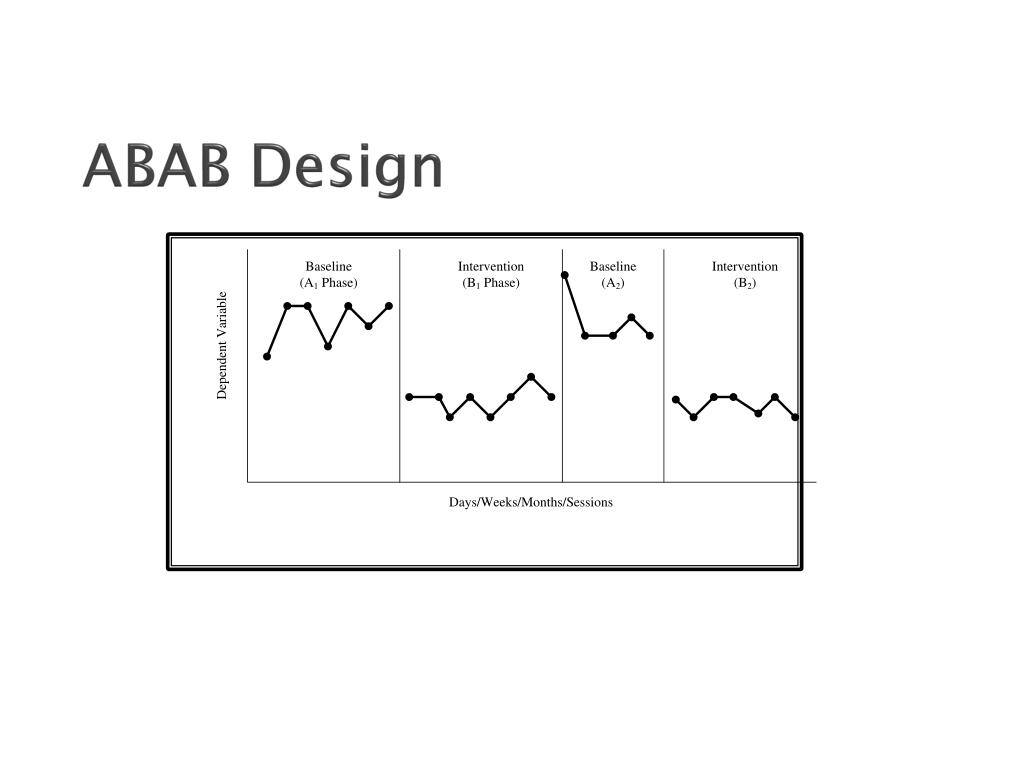
Practical application of withdrawal designs should be considered when feasible and ethical to inform ongoing implementation within client treatment. For additional information and description on the use of SCD’s, including withdrawal designs, see (Alnahdi, 2015; Krasny-Pacini & Evans, 2018; Ledford et al., 2019; Ledford & Gast, 2018). In applied practice, withdrawal designs can have significant value in verifying the effectiveness of the intervention, so it can be continued to be utilized with confidence.
The Benefits of Healthcare Coordination for Autism
This condition further strengthened the evidence for the effectiveness of the intervention, as performance on all three words sets reached 100% by the end of the phase. In sum, the latency to change observed during the alternating treatments phase meant that this study merits a rating of moderate evidence in favor of the intervention. To meet the criterion of having at least three attempts to demonstrate an effect, studies using an ATD must include a direct comparison of three interventions, or two interventions compared with a baseline. To be considered as support for an evidence-based practice, this design would need to have incorporated a third intervention condition or to have begun with a baseline condition.
In a systematic replication, the methods from previous direct replication studies are used in a new setting, target behavior, group of participants, and so on [73]. The Raiff and Dallery study, therefore, was also a systematic replication of effects of internet-based CM to promote smoking cessation to a new problem and to a new group of participants because the procedure had originally been tested with adult smokers [24]. Effects of internet-based CM for smoking cessation also were systematically replicated in an application to adolescent smokers using a single-case design [74]. A component analysis is “any experiment designed to identify the active elements of a treatment condition, the relative contributions of different variables in a treatment package, and/or the necessary and sufficient components of an intervention” [69].
Harnessing the Power of Visuals: Supporting Individuals with Autism
By carefully considering the similarities, differences, and specific requirements of your study, you can make an informed decision about whether ABA or ABAB design is the most suitable for your research objectives. Finally, the last "A" is the step when the analyst will remove the intervention to see if it is having a positive effect. The first part of the ABAB design is where the analyst gathers the baseline information on the behavior they are trying to change. Some interventions may increase over time while others grow weaker as the person being studied becomes accustomed to the intervention. In this simulation study, we will sample εt from a standard normal distribution or from a first-order autoregressive model (AR1) model. Songbird Therapy is a technology-enabled provider setting a higher standard for children’s autism care.
The ABAB design can provide valuable insights into the effectiveness of interventions for individuals with autism. One of the great scientific strengths of SSEDs is the premium placed on internal validity and the reliance on effect replication within and across participants. One of the great clinical strengths of SSEDs is the ability to use a response-guided intervention approach such that phase or condition changes (i.e., changes in the independent variable) are made based on the behavior of the participant. This notion has a long legacy and reflects Skinner's (1948) early observation that the subject (“organism”) is always right. In contrast with these two strengths, there is a line of thinking that argues for incorporating randomization into SSEDs (Kratochwill & Levin, 2009).
(PDF) Creative Design Of Sitting Hug Machine In The Treatment Of Students With Autism - ResearchGate
(PDF) Creative Design Of Sitting Hug Machine In The Treatment Of Students With Autism.
Posted: Mon, 15 Oct 2018 23:01:36 GMT [source]
By targeting specific behaviors and implementing evidence-based strategies, ABA has shown promising results in promoting positive changes. While ABA is widely used in clinical and educational settings to address a range of behavioral challenges, ABAB Design is primarily utilized for experimental purposes to examine the effectiveness of interventions in controlled environments. It is important to note that ABAB Design may have limited generalizability to other individuals or settings. Despite these limitations, ABA design has proven to be an effective tool in understanding and modifying behavior, particularly in the field of autism intervention. It provides valuable insights into the effectiveness of behavior change strategies and helps inform evidence-based practices.
Admittedly, these criteria are self-serving in the sense that most of them constitute the strengths of SCDs, but they also apply to other research designs discussed in this volume. Next, we introduce SCDs and how they can be used to optimize treatment using parametric and component analyses. Throughout, we also highlight how these designs can be used during both the development and dissemination of behavioral health interventions.
Through its evidence-based practices and individualized approach, ABA therapy offers hope and opportunities for growth to individuals with autism and their families. ABA therapy is a comprehensive and individualized approach that focuses on analyzing and modifying behaviors. It is rooted in the principles of behaviorism, which emphasize the role of the environment in shaping behavior. The primary goal of ABA therapy is to increase adaptive behaviors and reduce problematic behaviors by systematically applying interventions based on behavioral principles. To examine the predictive properties of effect size, we calculated the probability of failing to replicate the effects observed in the initial AB component (i.e., clear change or no clear change) given values above or lower certain effect size thresholds. The probability of failing to replicate the results is akin to the decision error rate produced by not conducting a replication.
Combining SCD results in meta-analyses can yield information about comparative effects of different treatments, and combing results using Bayesian methods may yield information about likely effects at the population level. First, a single case does not mean “n of 1.” The number of participants in a typical study is almost always more than 1, usually around 6 but sometimes as many as 20, 40, or more participants [24, 25]. Also, the unit of analysis, or “case,” could be individual participants, clinics, group homes, hospitals, health care agencies, or communities [1]. Given that the unit of analysis is each case (i.e., participant), a single study could be conceptualized as a series of single-case experiments. Second, SCDs are not limited to interventions that produce large, immediate changes in behavior. They can be used to detect small but meaningful changes in behavior and to assess behavior that may change slowly over time (e.g., learning a new skill) [27].
Other investigators have also shown that single-subject research tends to yield large effect sizes (Ferron & Levin, 2014; Marquis et al., 2000; Rogers & Graham, 2008). Thus, we conducted a second study to more carefully consider the relationship between effect size and replicability. For each ABAB graph, we extracted the data from the four phases using WebPlotDigitizer, a free web-based app designed to provide the value of data points on graphs (version 3.9; Rohatgi, 2017). Previous research has shown that, when applied to single-subject research, this app renders data of adequate accuracy (Moeyaert, Maggin, & Verkuilen, 2016). We entered the resulting data values into a spreadsheet and specified the purpose of the treatment (i.e., increase or decrease behavior), which we subsequently used to conduct the analyses described in the following sections.


No comments:
Post a Comment